Minimal APIs in .NET 10: Building Scalable, Lightweight Microservices for Enterprise Apps
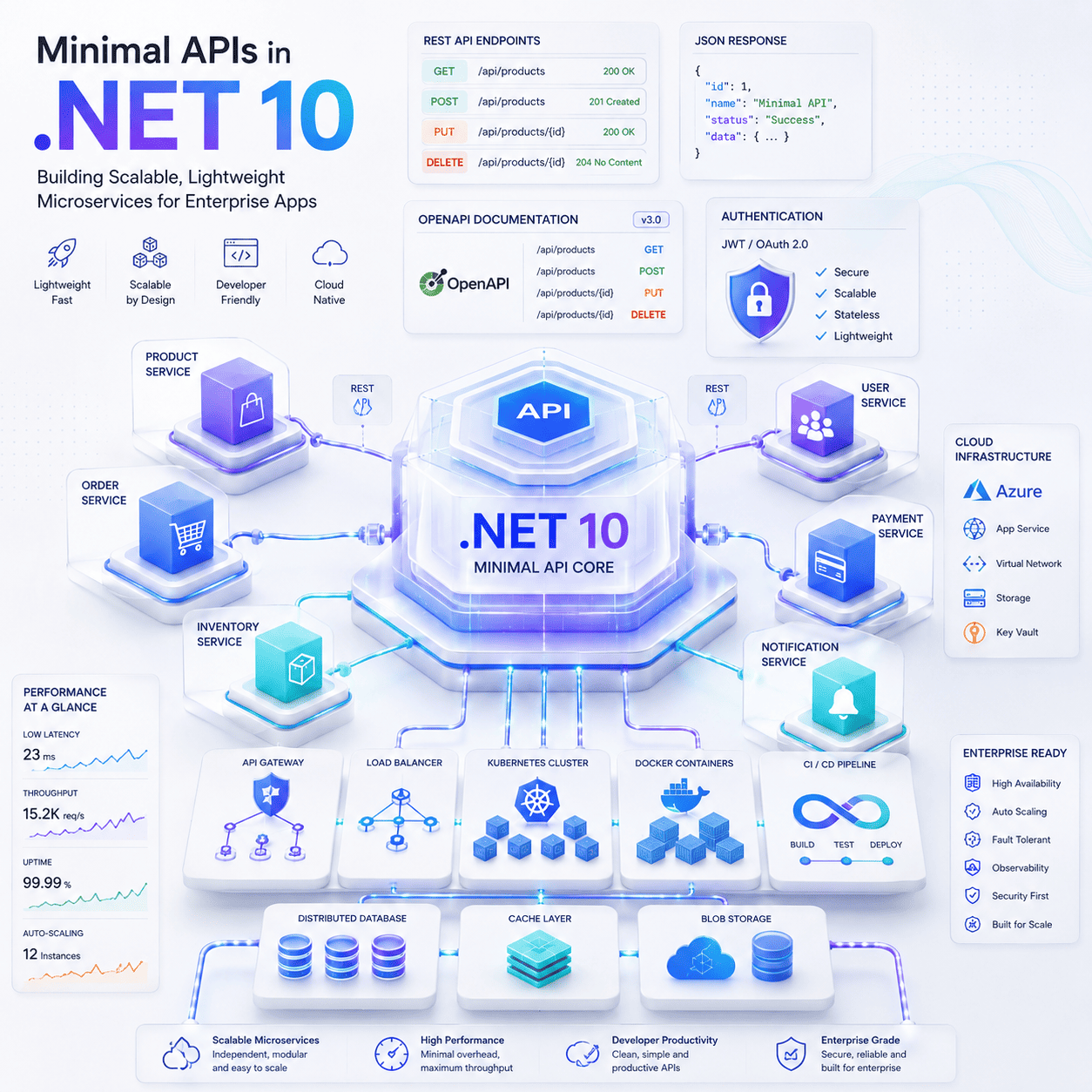
In this guide, we evaluate why Minimal APIs are ideal for microservices, explore key enhancements introduced in .NET 10, and provide best-practice patterns for maintaining clean architecture as your codebase expands.
Why Minimal APIs Are Built for Microservices
Microservices thrive on single-purpose, highly decoupled endpoints that start fast, scale horizontally, and consume minimal server resources. Traditional controller setups bring routing tables, model-binding filters, and class abstractions that can add subtle latency and memory overhead.
+-----------------------------------------------------------------------+
| TRADITIONAL CONTROLLER PIPELINE                                        |
| [HTTP Request] -> Routing -> Controller Activation -> Model Binder   |
|                 -> Action Filters -> Execute Method -> Return JSON   |
+-----------------------------------------------------------------------+

+-----------------------------------------------------------------------+
| MINIMAL API PIPELINE (.NET 10)                                        |
| [HTTP Request] -> Route Match -> Execute Direct Lambda -> Return JSON |
+-----------------------------------------------------------------------+
Key Advantages for Cloud-Native Backends:
Lower Overhead & Reduced Latency: Bypassing the MVC controller instantiation cycle results in faster request processing and higher throughput under heavy load.
Native AOT Compatibility: Minimal APIs integrate seamlessly with .NET 10 Native AOT compilation, reducing application cold-start times to milliseconds and keeping deployment container sizes under 15–20 MB.
Simplified Route Mapping: Defining endpoints with functional lambda expressions reduces boilerplate code without sacrificing dependency injection or security context.
Key .NET 10 Enhancements for Enterprise Minimal APIs
Building enterprise-grade microservices requires robust validation, observability, and structured endpoint management. Recent updates in .NET 10 make Minimal APIs production-ready out of the box:
1. Built-in Endpoint Validation & Route Groups
Instead of repeating middleware checks across multiple routes, .NET 10 allows developers to group endpoints logically (e.g., /api/v1/orders) and apply authentication, rate-limiting, and validation schemas cleanly across the entire group:
var orders = app.MapGroup("/api/v1/orders")
    .WithTags("Orders")
    .RequireAuthorization();

orders.MapGet("/{id:guid}", GetOrderById);
orders.MapPost("/", CreateOrder).WithParameterValidation();
2. Native OpenAPI Document Generation
Native OpenAPI document generation simplifies contract generation. Integrated natively into WebApplicationBuilder, services automatically expose clean, standard specifications without requiring third-party library hacks:
builder.Services.AddOpenApi();

var app = builder.Build();
app.MapOpenApi(); // Generates OpenAPI 3.1 documentation natively
3. Integrated Caching with HybridCache
High-volume microservices often hit database bottlenecks. The HybridCache API introduced in recent .NET releases provides a two-tier caching strategy (in-memory L1 + distributed L2 Redis) that protects against cache stampedes natively within Minimal API handlers.
Structuring Minimal APIs for Long-Term Scalability
A common concern with Minimal APIs is that Program.cs can quickly become cluttered if all endpoints, middleware, and dependency injections live in a single file.
To ensure long-term maintainability in large-scale applications, adopt a Modular Extension Pattern to decouple route definitions from business logic:
Step 1: Extract Endpoints into Extension Methods
Create dedicated endpoint modules for each domain feature rather than declaring them inside Program.cs:
public static class OrderModule
{
    public static void MapOrderEndpoints(this IEndpointRouteBuilder app)
    {
        var group = app.MapGroup("/api/v1/orders").WithTags("Orders");

        group.MapGet("/{id:guid}", GetOrderById);
        group.MapPost("/", CreateOrder);
    }

    private static async Task<IResult> GetOrderById(Guid id, IOrderService orderService)
    {
        var order = await orderService.GetByIdAsync(id);
        return order is not null ? Results.Ok(order) : Results.NotFound();
    }

    private static async Task<IResult> CreateOrder(CreateOrderDto dto, IOrderService orderService)
    {
        var result = await orderService.CreateAsync(dto);
        return Results.Created($"/api/v1/orders/{result.Id}", result);
    }
}
Step 2: Keep Program.cs Clean
Your primary entry point remains concise, focused purely on bootstrap configuration and registration:
var builder = WebApplication.CreateBuilder(args);

// Register Core Services
builder.Services.AddOpenApi();
builder.Services.AddScoped<IOrderService, OrderService>();

var app = builder.Build();

// Register Endpoint Modules
app.MapOrderEndpoints();

app.Run();
Minimal APIs vs. Controllers: Architectural Decision Matrix
While Minimal APIs excel in microservice environments, standard MVC Controllers still have a role in specific application designs.
Metric / Scenario | Minimal APIs (.NET 10) | Controller-Based APIs |
Primary Use Case | Microservices, Serverless, Lightweight APIs | Large Legacy Monoliths, Web Apps with Views |
Startup / Boot Time | Near Instantaneous (AOT Friendly) | Slower due to controller discovery scan |
Memory Footprint | Extremely Low | Moderate to High |
Code Organization | Functional / Route Groups / Extension Modules | Class-based Controller Files |
Complexity Threshold | Ideal for focused domain services | Better for complex custom model bindings |
Conclusion: Building Modern Backends with Printf Tech
Minimal APIs in .NET 10 provide the foundation for modern microservices—offering exceptional execution speed, lower cloud hosting costs, and streamlined maintainability. By pairing route groups with modular design patterns, engineering teams can build scalable backend platforms without the structural bloat of legacy frameworks.
At Printf Technologies, our engineering teams specialize in architecting high-performance enterprise applications, modernized backends, and cloud-native solutions powered by .NET, React, and advanced digital infrastructure.
Looking to modernize your backend architecture or transition legacy monoliths to high-performance microservices?
Contact our technical engineering team at Printf Tech to discuss your next software project.