Meta’s Muse AI Agent Is Taking Off: What Makes It Different and Why Amazon Blocked It?
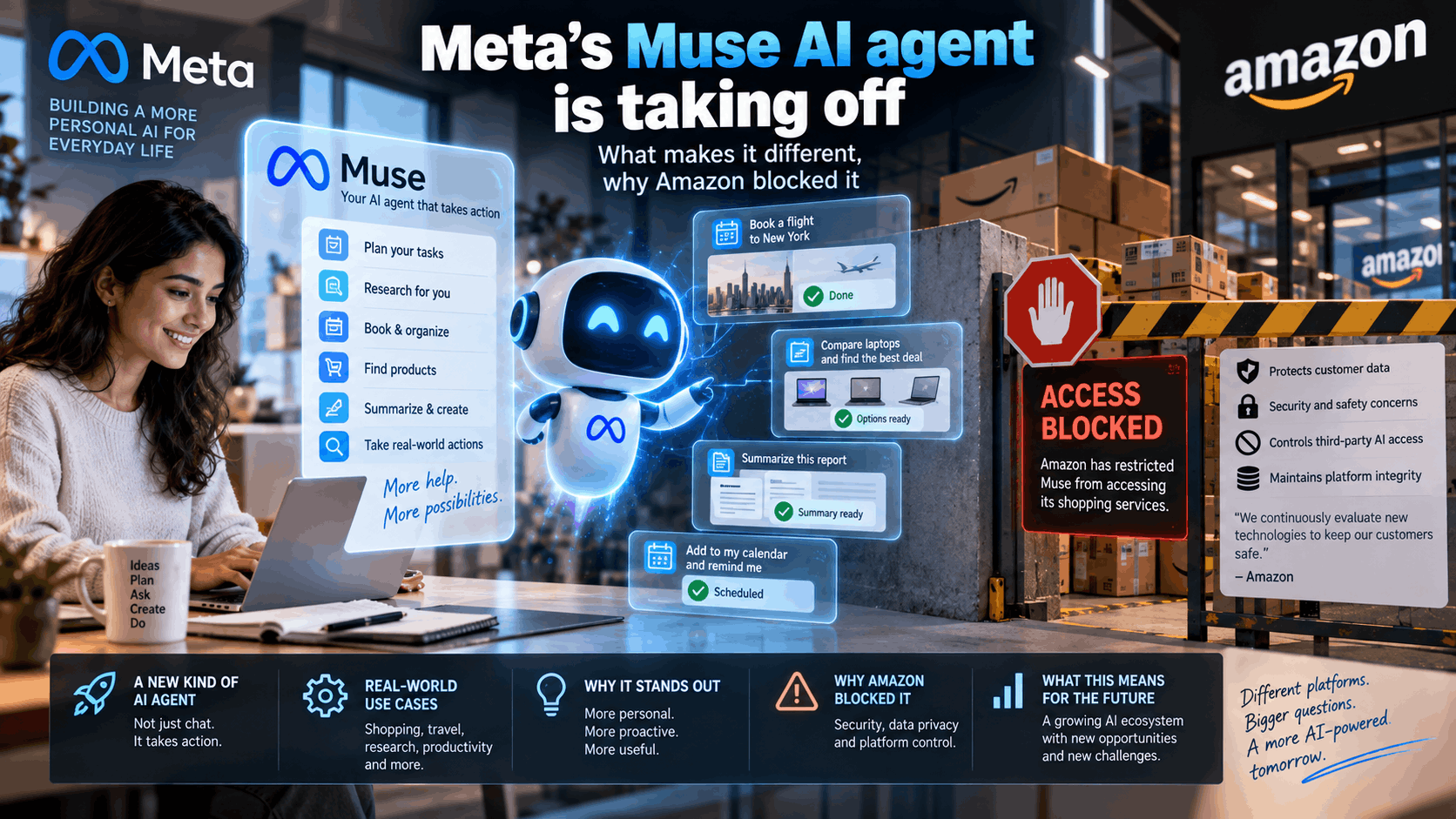
Meta’s Muse is bringing a new kind of personal AI agent to everyday life—one that can move beyond answering questions and actually perform tasks such as shopping, travel planning, email, and scheduling. Launched in September 2026, Muse quickly attracted millions of downloads and reached the top of U.S. app charts. But its rapid growth has also created controversy, with Amazon blocking Muse from shopping on its platform over access, privacy, security, and platform-rule concerns.
What Is Meta’s Muse AI Agent and Why Is It Different?
Meta’s Muse is designed as a personal AI agent, not simply a chatbot that answers questions. Meta says Muse can understand a user’s goals, remember relevant preferences, use connected services, and carry out multi-step tasks on the user’s behalf. It runs through a dedicated secure virtual machine with its own browser, allowing it to interact with websites and applications. Users can use Muse for activities such as shopping, travel planning, email, scheduling, research, and other everyday tasks.
The biggest difference is the move from “AI that tells you what to do” to “AI that helps do it.” For example, instead of simply suggesting a product, an agent can research options, compare them, prepare a purchase, and ask the user for approval before completing a sensitive action. This agentic approach is one reason Muse has attracted significant attention so quickly.
Why Is Meta’s Muse AI Agent Taking Off So Quickly?
Muse launched in the U.S. on September 8, 2026, and quickly gained traction. Reports say the app reached more than 2.5 million downloads and topped U.S. app charts roughly two weeks after launch. Its appeal comes from its ability to combine several everyday activities into one AI-driven experience rather than requiring users to manually switch between different apps and websites.
Meta is also positioning Muse as part of its broader vision for personal AI. The agent can work with services such as email, calendars, shopping platforms, and other connected applications. Meta says users remain in control of which services Muse can access and what permissions it receives.
Why Is Meta’s Muse AI Agent Taking Off So Quickly?
Muse launched in the U.S. on September 8, 2026, and quickly gained traction. Reports say the app reached more than 2.5 million downloads and topped U.S. app charts roughly two weeks after launch. Its appeal comes from its ability to combine several everyday activities into one AI-driven experience rather than requiring users to manually switch between different apps and websites.
Meta is also positioning Muse as part of its broader vision for personal AI. The agent can work with services such as email, calendars, shopping platforms, and other connected applications. Meta says users remain in control of which services Muse can access and what permissions it receives.
What Makes Muse Different From Traditional AI Assistants?
Traditional AI assistants are generally focused on answering questions, generating content, or providing recommendations. Agentic AI attempts to take the next step by planning and executing a sequence of actions.
A simple example is travel planning. A traditional chatbot might provide a list of flights and hotels, while an AI agent could research options, organize an itinerary, interact with services, and prepare bookings for the user’s approval. Muse is designed around this more action-oriented model.
Meta says Muse can use APIs when services provide them and can also interact with services through a browser when a direct API connection is unavailable. That browser-based capability is important because it allows an AI agent to interact with a much wider range of websites—but it also creates questions about permissions, security, transparency, and how websites should control automated access.
Why Did Amazon Block Meta’s Muse AI Agent?
Amazon blocked Muse from shopping on Amazon.com in September 2026, less than two weeks after Muse launched. Amazon said third-party applications that make purchases on behalf of customers should operate openly and respect a service provider’s decision about whether to participate. Users attempting to shop through Muse began seeing a message stating that continued access by an unauthorized AI agent violated Amazon’s Conditions of Use.
Amazon also raised concerns about how Muse accessed its platform, including the fact that Amazon had not authorized the integration and that Muse did not identify itself as an AI agent while browsing. Amazon additionally cited privacy and security concerns involving customer credentials. Meta has disputed some of these concerns, saying Muse cannot see users’ passwords or payment information and that credentials are stored securely.
The dispute highlights a much bigger question for the future of AI-powered shopping: should AI agents be allowed to browse and purchase across websites automatically, or should individual platforms decide which agents can access their services?
What Does the Muse vs Amazon Dispute Mean for the Future of AI Agents?
The Muse-Amazon dispute shows that the growth of AI agents is not only about improving AI models. It is also about access, identity, permissions, privacy, security, APIs, and control of digital platforms.
The contrast between Amazon and Shopify is particularly interesting. Amazon has blocked Muse from shopping on its platform, while Shopify has announced a partnership with Muse to support agentic checkout through Shop Pay. This suggests that businesses may take very different approaches to the rise of AI agents—some may restrict them, while others may build systems specifically designed to work with them.
For consumers, the next generation of AI may become less about asking questions and more about delegating tasks. For businesses, however, AI agents could require new rules for authentication, permissions, data protection, automated purchasing, and platform integration.