FinOps Meets DevOps: How Teams Can Control Cloud Costs Without Slowing Development
applications. Developers can create infrastructure quickly, scale applications when traffic increases, and release new features without waiting for physical hardware.
But there is another side to this flexibility: cloud costs can grow quickly when resources are not managed properly.
This is where FinOps comes in.
FinOps brings financial awareness into technology and encourages engineering, finance, product, and business teams to work together. The goal is not simply to spend less money. It is to make sure every cloud resource provides useful business value.
What Is FinOps?
FinOps is a combination of financial management, technology, and teamwork. It helps organizations understand how much they are spending on cloud and other technology services and why they are spending it.
According to the FinOps Foundation, modern FinOps focuses on maximizing the business value of technology through collaboration between engineering, finance, and business teams.
In simple words, FinOps helps answer questions such as what we are spending, where the money is going, whether cloud resources are being used efficiently, and whether the cost is providing enough business value.
Instead of waiting until the end of the month to discover a large cloud bill, teams can continuously monitor usage and make better decisions.
Why Cloud Costs Can Become Difficult to Control
One of the biggest advantages of cloud computing is that teams can create resources whenever they need them.
A developer might create a virtual machine for testing. Another team may create a database for a new application. A DevOps engineer may increase the number of servers to handle higher traffic.
The problem starts when these resources are no longer needed but continue running.
Unused virtual machines, oversized servers, unnecessary storage, excessive data transfer, and environments that run 24/7 can all increase cloud spending.
Cloud also uses a consumption-based pricing model in many cases, which means your bill changes based on usage.
This flexibility is useful for development, but it also requires better visibility and control.
FinOps and DevOps: Why They Work Better Together
DevOps focuses on improving the software development and delivery process by bringing development and operations teams together.
FinOps adds another important question: how much does this technology decision cost, and what value does it provide?
For example, increasing server capacity may improve performance, but it also increases cost. Teams need to understand both sides.
This does not mean developers must become finance experts. Instead, FinOps gives them better cost visibility so they can make informed technical decisions.
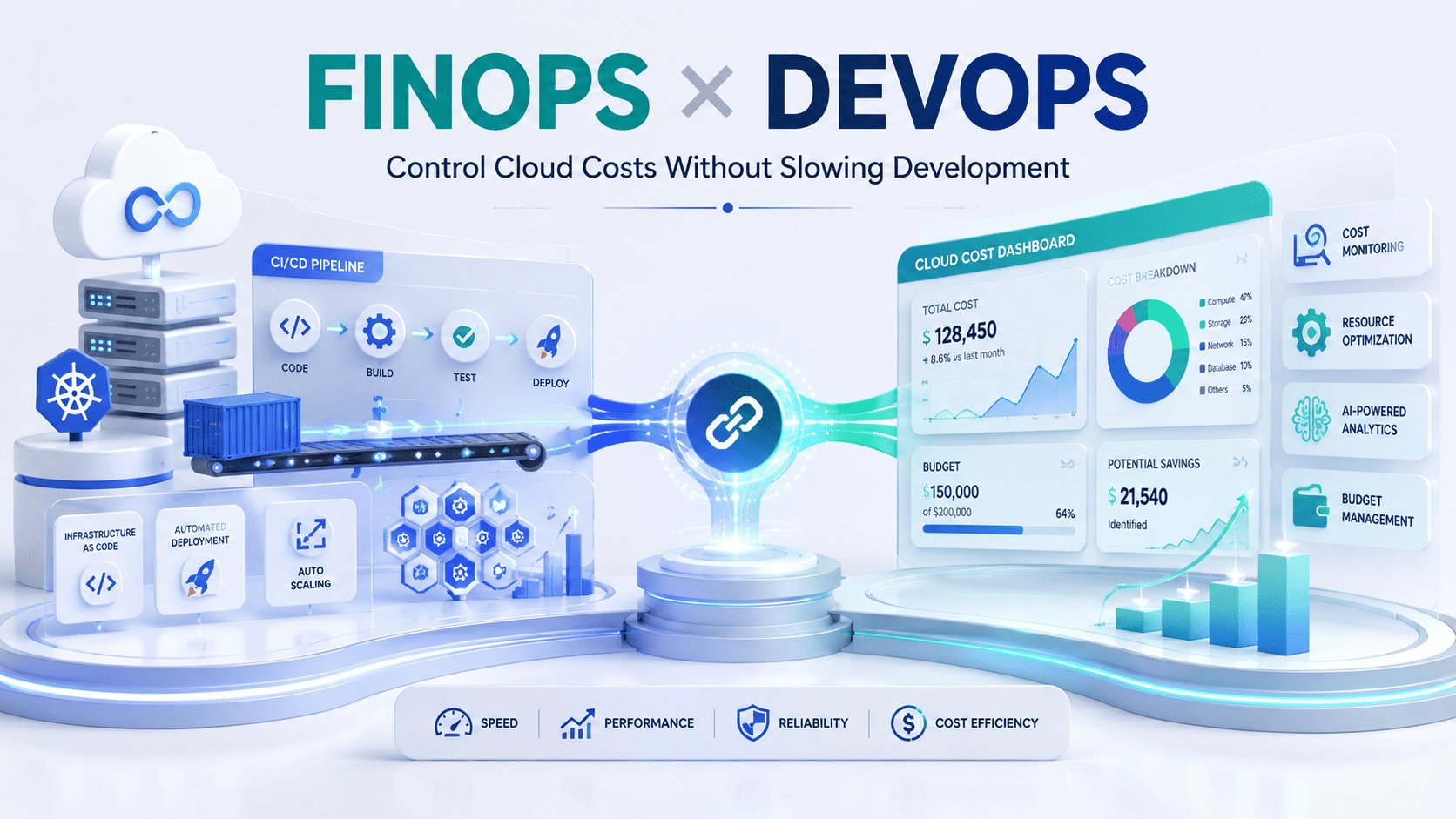
The result is a balance between performance, speed, reliability, and cost.
Cloud Cost Optimization Is Not About Choosing the Cheapest Option
A common misunderstanding is that cloud cost optimization means always choosing the cheapest resources.
This is not correct.
If a company reduces server size too much, performance may drop and customers may leave, causing greater losses than the savings.
Good optimization focuses on balance.
Teams should consider cost, performance, reliability, security, scalability, and business value.
The goal is to maximize value, not just reduce spending.
Give DevOps Teams Visibility Into Cloud Spending
Visibility is the first step toward cost control.
Teams should understand which applications, environments, or departments are responsible for cloud usage.
Instead of one large bill, costs can be broken into categories like production, development, testing, marketing, and customer applications.
This makes it easier to identify where spending is increasing.
Cost allocation, tagging, dashboards, and reporting help connect usage with business activity.
Remove Unused Cloud Resources
Unused resources are one of the easiest ways to reduce cloud waste.
Development and testing environments often create temporary resources that are forgotten after use.
Servers, databases, storage volumes, IP addresses, and snapshots can continue running even when not needed.
A cleanup process helps reduce unnecessary costs.
Automation can also be used to remove temporary resources without relying on manual work.
The Future of FinOps and DevOps
FinOps is expanding beyond cloud billing into SaaS, AI, and data platforms.
AI will play a bigger role in analyzing and optimizing cloud costs.
DevOps teams will need to balance speed, reliability, and cost more carefully in the future.
Final Thoughts
FinOps and DevOps are not competing ideas. They work together.
DevOps focuses on speed and delivery, while FinOps focuses on cost and value.
Together, they help organizations build systems that are fast, reliable, scalable, and cost-efficient.
The goal is simple: use the right resources, at the right time, for the right business value.