AI Agents Are Coming to UPI: Can AI Make Payments Without You?
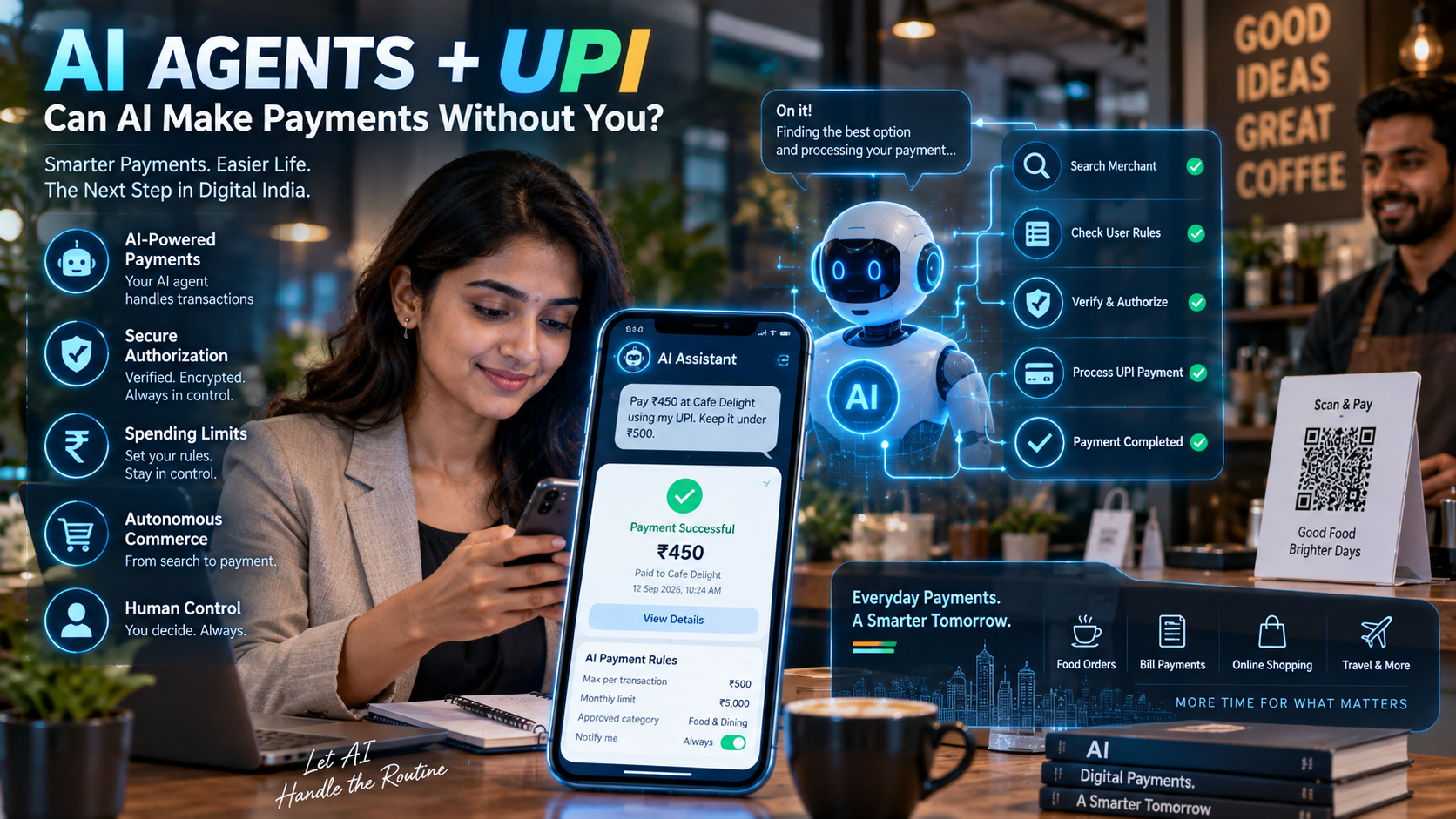
AI agents could soon become capable of making certain UPI payments on behalf of users. Explore how agentic payments may work, how NPCI is developing an authorization framework for AI agents, and what this could mean for the future of digital payments, security, and autonomous commerce.
AI Agents Could Change the Way We Make UPI Payments
Artificial Intelligence is moving beyond answering questions and generating content. AI agents are increasingly being designed to perform tasks on behalf of users. One of the most interesting possibilities is allowing AI agents to handle digital payments.
India is now exploring how AI agents could be identified and authorized within the UPI ecosystem. NPCI is working on protocols intended to allow trusted AI agents to conduct certain transactions on behalf of users.
What Is an AI Agent?
An AI agent is a software system that can understand a user's goal and perform multiple steps to complete a task.
For example, instead of simply asking an AI assistant where to buy groceries, you could eventually tell it:“Buy my regular groceries for up to ₹2,000.”The AI agent could potentially find the products, select an appropriate option, place the order, and complete an authorized payment.This is different from a traditional chatbot because the agent can potentially take action instead of only providing information.
What Is Agentic Payment?
Agentic payment means an AI agent performs a payment-related action on behalf of a user within predefined permissions.Instead of the user manually completing every step, the user could provide instructions and limits.
For example:
“Pay my monthly electricity bill when it arrives, up to ₹5,000.”
The AI agent could identify the bill and initiate the payment according to the rules given by the user.India's proposed approach is aimed at creating trusted mechanisms for this type of interaction with UPI.
How Could AI Payments Work With UPI?
The basic process could look like this:
User gives permission → AI agent understands the task → Agent checks payment rules → Agent identifies the transaction → Payment is authorized → UPI processes the payment → User receives confirmation
The important part is authorization.An AI agent should not simply have unlimited access to a user's bank account.
Instead, the system could use controls such as:
Spending limits
Transaction rules
Identity verification
Approved AI agents
Payment permissions
Transaction monitoring
User-defined conditions
These controls are important because an AI agent would be acting on behalf of a real person.
Why Is NPCI Working on AI Agent Authorization?
UPI was designed primarily around users, merchants, banks, and payment applications.AI agents introduce another participant: software acting on behalf of a user.That creates a new requirement.
The payment ecosystem needs to know:
Who is the AI agent?
Who authorized it?
What is it allowed to do?
How much can it spend?
Who is responsible if something goes wrong?
According to recent reporting, NPCI is developing a registry/framework to identify and monitor AI agents as part of its planned agentic-payment infrastructure.
Could AI Make Small Everyday Payments?
One of the most practical applications could be routine, low-value purchases.
For example, users could potentially authorize an AI agent to handle:
Grocery purchases
Food orders
Utility bills
Subscription payments
Regular household purchases
Travel bookings
Other routine transactions
The idea is not necessarily to give AI unlimited access to money.Instead, users could give the AI specific permissions and spending boundaries.Recent reporting indicates that initial agentic-payment use cases are expected to focus on smaller and routine transactions.
What Would a Real-World Example Look Like?
Imagine you tell your AI assistant:
“Every Friday, check whether I need my regular household supplies. You can spend up to ₹1,500.”
The AI agent could potentially:
Check the user's predefined shopping list.
Search for available products.
Compare prices.
Select products according to the user's rules.
Calculate the total.
Check the spending limit.
Initiate the authorized UPI payment.
Provide the user with a transaction summary.
The user would not necessarily need to manually open a payment application for every small transaction.This is the basic idea behind agentic commerce.
Will AI Have Unlimited Access to Your Bank Account?
This is one of the biggest questions surrounding agentic payments.The answer should be no.A safe agentic-payment system needs clear boundaries.
For example, a user might allow an AI agent to spend:
₹2,000 per transaction or ₹10,000 per month, The user could also restrict the types of transactions the agent can perform.
This type of permission-based system can reduce the risk of an AI agent making an unexpected high-value payment.
Why Security Is So Important
Giving an AI agent the ability to make payments creates new security challenges.Imagine an AI agent misunderstands a user's instruction or is manipulated by malicious information.It could potentially select the wrong product, send money to the wrong merchant, or make an unauthorized transaction.Therefore, agentic payments need strong security mechanisms.
Important areas could include:
AI agent authentication
User identity verification
Transaction limits
Fraud detection
Payment monitoring
Secure authorization
Audit trails
Emergency controls
User notifications
The payment system needs to verify not only the transaction but also whether the AI agent is authorized to perform it.
What Happens If an AI Agent Makes a Mistake?
This is another major challenge. Suppose an AI agent is asked to purchase groceries for ₹1,500 but accidentally places an order worth ₹15,000.
Who is responsible?
The user?
The AI provider?
The payment company?
The merchant?
The bank?
These questions need clear rules.
Recent reporting on India's proposed framework has highlighted liability and regulatory questions as important issues that still need to be addressed.
What Is the Difference Between AI Payment Assistance and AI Payment Agents?
There is an important difference.AI Payment Assistant. An AI assistant mainly helps the user.
For example:
“Why did my UPI payment fail?”
The AI provides information or guides the user.AI Payment Agent. An AI agent can potentially take action.
For example:
“Pay my electricity bill every month up to ₹5,000.”
The agent could potentially perform the transaction under predefined permissions.
This shift—from AI that helps to AI that acts—is one of the biggest changes happening in the AI industry.