Agentic AI in Manufacturing: Can AI Agents Run Factory Operations?
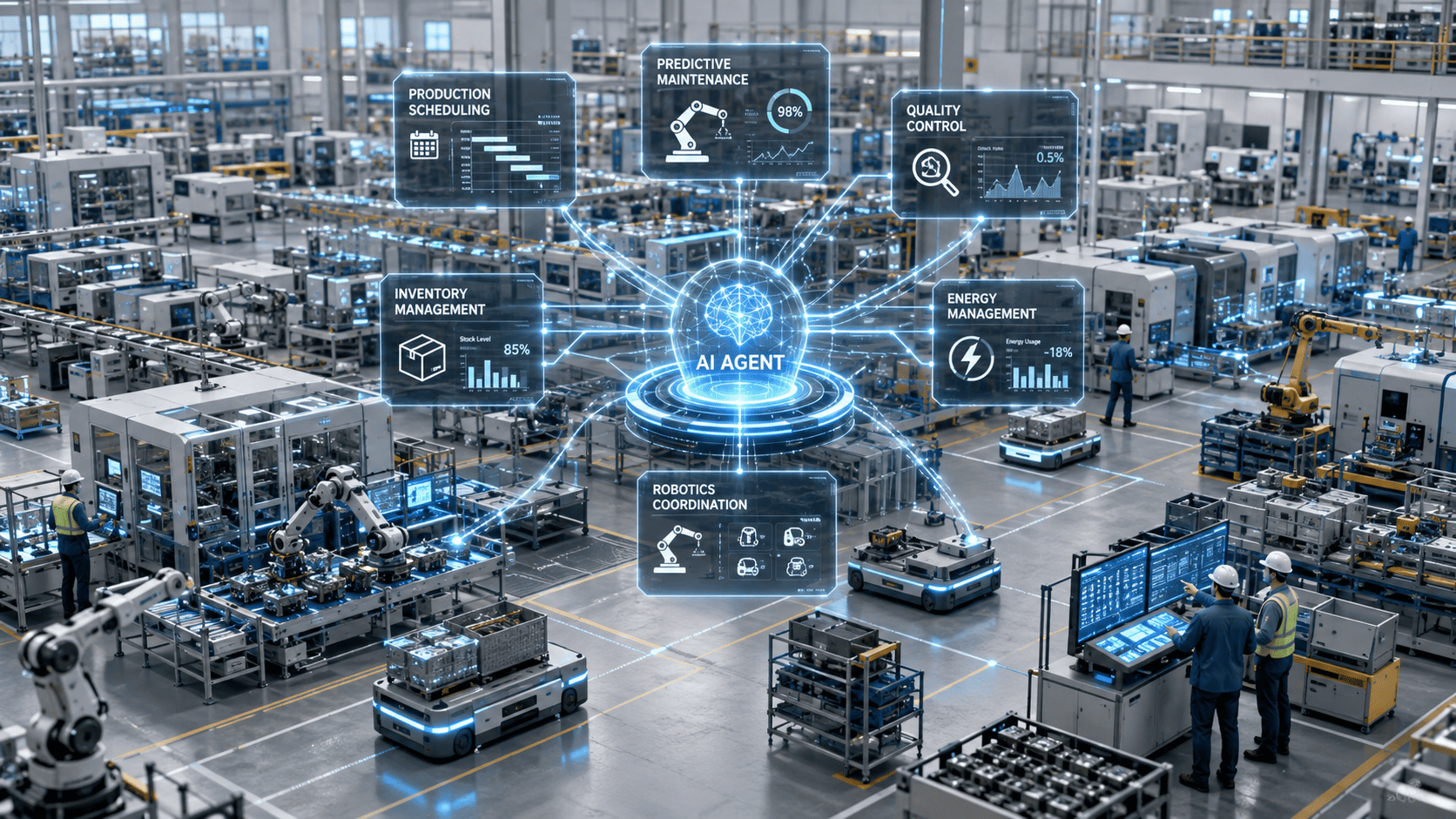
Manufacturing is changing quickly. Factories are becoming more connected, automated, and data-driven. Robots, sensors, industrial software, and artificial intelligence are already helping companies improve production. The next major development is Agentic AI.
Agentic AI refers to AI systems that can understand a goal, analyze information, make decisions, plan actions, and adjust their approach based on what happens next. Unlike traditional automation, which usually follows fixed instructions, AI agents can handle changing situations and choose what action should happen next.
In manufacturing, this could help factories move from simple automation toward more intelligent and autonomous operations.
Traditional Automation vs Agentic AI
Traditional factory automation works mainly through predefined rules. For example, if a machine reaches a specific temperature, the system may automatically turn it off. The action has already been programmed by an engineer.
Agentic AI works differently. It can analyze multiple sources of information before deciding what to do. For example, if a machine starts showing unusual behavior, an AI agent could analyze sensor readings, maintenance records, production schedules, and previous failures before recommending the next step.
In simple terms, traditional automation follows instructions, while agentic AI can make decisions based on a goal and the information available to it.
How Does Agentic AI Work in a Smart Factory?
An AI agent can act as an intelligent layer between factory data, manufacturing software, machines, and people.
Sensors collect information from machines and production lines. That information can be sent to manufacturing systems and analyzed by an AI agent. The agent can identify problems, compare different options, decide on an action, and then provide a recommendation or trigger an approved workflow.
A simplified process looks like this:
Sensors → Factory Data → AI Agent → Decision → Action → Feedback
The feedback is important because the AI agent can use the result of an action to determine what should happen next.
Agentic AI Use Cases in Manufacturing
Agentic AI can potentially support many areas of manufacturing. Instead of focusing on one specific task, AI agents can connect information from different systems and help coordinate activities.
Here are some of the most promising applications.
Predictive Maintenance with AI Agents
Machine downtime can be extremely expensive for manufacturers. Predictive maintenance uses machine data to identify signs of possible equipment problems before a major failure occurs.
An AI agent could go a step further. It could monitor equipment continuously, identify unusual behavior, check maintenance history, look at production schedules, and recommend when maintenance should be performed.
For example, if a machine shows signs of a possible failure, the AI agent could alert the maintenance team, check whether replacement parts are available, and suggest a suitable maintenance window.
This could help manufacturers reduce unexpected downtime and improve equipment utilization.
AI-Powered Production Scheduling
Production scheduling can become complicated when factories have many machines, products, materials, employees, and delivery deadlines.
An AI agent could analyze these factors and help create better production schedules. If a machine becomes unavailable or a material delivery is delayed, the agent could analyze the situation and recommend a new schedule.
Instead of manually adjusting the entire production plan, manufacturers could use AI to quickly identify alternative options.
Quality Control with AI
Quality control is another important area where AI can help manufacturers.
Computer vision systems can already inspect products and identify defects. Agentic AI could potentially combine those inspection results with production data, machine conditions, and historical quality information.
For example, if the number of defects suddenly increases, an AI agent could investigate possible causes and recommend that engineers inspect a particular machine or production stage.
This can help manufacturers move from simply detecting defects to understanding why defects are happening.
Smart Inventory Management
Manufacturing depends on having the right materials available at the right time. Too little inventory can stop production, while too much inventory can increase storage costs.
AI agents can analyze inventory levels, production requirements, supplier information, demand forecasts, and delivery times.
Based on this information, an AI agent could identify materials that may need to be reordered and recommend when purchasing should happen.
With the right integrations and approval controls, some low-risk inventory workflows could potentially become partially automated.
Can AI Agents Run an Entire Factory?
This is one of the biggest questions surrounding agentic AI in manufacturing.
The short answer is: not completely today.
Manufacturing environments are complex and can involve safety-critical equipment, expensive machinery, strict quality requirements, and human workers. Giving an AI unrestricted control over an entire factory would create significant safety, reliability, and cybersecurity risks.
A more realistic approach is gradual automation.
AI can first act as an assistant, providing insights and recommendations. Then it can become a copilot, where humans approve its suggested actions. Later, AI agents can handle specific low-risk tasks automatically while humans remain responsible for important decisions.
The long-term goal could be highly autonomous factories where multiple AI systems coordinate many operational activities while human experts supervise the overall system.
Benefits of Agentic AI in Manufacturing
Agentic AI could provide several potential benefits for manufacturers.
It can help companies make decisions faster by analyzing large amounts of operational data. It could also help reduce machine downtime, improve production planning, identify quality problems, optimize inventory, reduce energy waste, and coordinate different manufacturing systems.
Another major advantage is continuous monitoring. Unlike humans, AI systems can analyze factory data continuously and identify changes that might otherwise be missed.
However, these benefits depend heavily on reliable data, good system integration, proper security, and appropriate human oversight.
The Future of Agentic AI in Manufacturing
Agentic AI could become an important part of the next generation of smart factories.
The future is unlikely to be about completely removing humans from manufacturing. Instead, it will be about combining human expertise, AI decision-making, robotics, industrial data, and connected systems.
AI agents could handle repetitive analysis and operational coordination while engineers and factory workers focus on complex decisions, innovation, safety, and problem-solving.
The result could be a manufacturing environment that is more responsive, efficient, and adaptable.
Conclusion
Agentic AI represents an important step beyond traditional manufacturing automation. Instead of simply following predefined instructions, AI agents can analyze information, work toward specific goals, make decisions, and adapt to changing conditions.
Although fully autonomous factories are still a developing concept, manufacturers can already explore AI agents in areas such as predictive maintenance, quality control, production scheduling, inventory management, energy optimization, and robotics.
The future of manufacturing may not be a factory without people. It may be a factory where humans and intelligent AI systems work together to make faster and better operational decisions.